Saturday, 21 February 2015

Evaluation - Question Six
6) What have you learnt about technologies from the process of constructing this product?
Friday, 20 February 2015
Evaluation - Question Seven
7) Looking back at your preliminary task, what do you feel you have learnt in the progression from it to the full product?
The purpose of my preliminary task was to learn how to use the equipment correctly and to learn how to execute many different shots that we would be using in our own opening thriller sequence. I had to familiarise myself with different pieces of equipment such as the camera, the importance of the memory card and the tripod.
I learnt through my preliminary task that we could experience many difficulties in using the tripod in the correct manor and keeping it stable and positioned correctly with the camera inside as we moved it around and manoeuvred it in different angles in order for us to film the different shots correctly. I experienced so many difficulties whilst trying to use the tripod in the preliminary task that I decided to use a hand-held camera technique in order to film the preliminary task. We decided to turn to the hand-held camera technique because the shots we were producing whilst filming with the tripod was of low quality and were very shaky and unable to watch comfortably and easily. I later discovered that even this technique make the shots look very unstable and that I would have to practise using the tripod and inserting the camera into the tripod correctly so we could then be comfortable with using the tripod when filming our own thriller sequence in order for it to look professional and well executed.
Some of the skills that I learnt through my preliminary task was how to use the camera in a way that I could improve my work. Due to the touch-screen element on the camera I was able to watch back any clips that I had filmed as many times as I liked to see what had gone well and what needed improving once I had watched it back. This helped me to understand that some aspects of mise-en-scene and sometimes the cinematography that I had chosen may not have been the best choice for the particular shot I was trying to film. This helped me when filming my opening thriller sequence because it gave me the chance to watch back what I had filmed and improve it so I had the best possible shot I could have produced ready to edit and produce on Final Cut Pro X.
Overall I believe that my group worked well in considering the appropriate research and ideas in order to create a successful opening thriller sequence. My thriller production follows the relevant and appropriate guidelines and also the generic conventions of the thriller genre. This helps to attract our target audience and give them a potential narrative that will scare them and make them want to carry on watching the film.
The purpose of my preliminary task was to learn how to use the equipment correctly and to learn how to execute many different shots that we would be using in our own opening thriller sequence. I had to familiarise myself with different pieces of equipment such as the camera, the importance of the memory card and the tripod.
I learnt through my preliminary task that we could experience many difficulties in using the tripod in the correct manor and keeping it stable and positioned correctly with the camera inside as we moved it around and manoeuvred it in different angles in order for us to film the different shots correctly. I experienced so many difficulties whilst trying to use the tripod in the preliminary task that I decided to use a hand-held camera technique in order to film the preliminary task. We decided to turn to the hand-held camera technique because the shots we were producing whilst filming with the tripod was of low quality and were very shaky and unable to watch comfortably and easily. I later discovered that even this technique make the shots look very unstable and that I would have to practise using the tripod and inserting the camera into the tripod correctly so we could then be comfortable with using the tripod when filming our own thriller sequence in order for it to look professional and well executed.
Some of the skills that I learnt through my preliminary task was how to use the camera in a way that I could improve my work. Due to the touch-screen element on the camera I was able to watch back any clips that I had filmed as many times as I liked to see what had gone well and what needed improving once I had watched it back. This helped me to understand that some aspects of mise-en-scene and sometimes the cinematography that I had chosen may not have been the best choice for the particular shot I was trying to film. This helped me when filming my opening thriller sequence because it gave me the chance to watch back what I had filmed and improve it so I had the best possible shot I could have produced ready to edit and produce on Final Cut Pro X.
Overall I believe that my group worked well in considering the appropriate research and ideas in order to create a successful opening thriller sequence. My thriller production follows the relevant and appropriate guidelines and also the generic conventions of the thriller genre. This helps to attract our target audience and give them a potential narrative that will scare them and make them want to carry on watching the film.
Thursday, 19 February 2015
Evaluation - Question Three
3) What kind of media institution might distribute your media product and why?
Evaluation - Question Two
2) How does your media product represent particular social groups?
My media production consists of three characters who are all searching for a missing dog. These characters consist of two boys and one girl. Instantly the audience would expect the girl to be the victim as she is the only girl making her vulnerable which is conventional to the thriller genre as the female characters are usually seen to be vulnerable, weak and inferior. However this is where I challenged the conventions and made the girl character in the production a secret antagonist. This is unconventional as girls are seen to be powerless against men in this genre who are seen as powerful, strong and dominant and are mostly always the protagonist characters. This is where I also challenged the conventions by making one of the male characters the victim and having him murdered by the female antagonist. This isn't gender stereotypical as females are always seen to be less inferior to men in everyday life as they are always seen as the stronger character physically and mentally. Although I challenged the conventions due to the power of the characters I did however still make them relatable to the target audience I had aimed the piece at. The characters in my piece are all teenagers of 16 and 17 which is also the age of my target audience of teenagers to young adults with an age of roughly 15-25. I made our characters to be of similar ages to the target audience so that the audience can relate to them and ultimately imagine themselves in the situations which will scare them more when bad things happen to the characters of their similar ages.
The characters in my piece all wore costumes that the target audience could relate to by wearing casual everyday clothes such as jeans, converse, a top and a coat. This is what the audience would expect the characters to be wearing whilst on a winters day in the forest as this is what they would consider wearing themselves. The female character also wore minimal makeup and had a casual down hair-do. The only other makeup used was fake blood around her mouth on the reveal of her as the antagonist to show that she had clearly killed someone and their blood remained on her face. This is where the audience could be surprised and shocked as they wouldn't expect a female of this age to be able to do such a thing and have overcome a male character.
My media production consists of three characters who are all searching for a missing dog. These characters consist of two boys and one girl. Instantly the audience would expect the girl to be the victim as she is the only girl making her vulnerable which is conventional to the thriller genre as the female characters are usually seen to be vulnerable, weak and inferior. However this is where I challenged the conventions and made the girl character in the production a secret antagonist. This is unconventional as girls are seen to be powerless against men in this genre who are seen as powerful, strong and dominant and are mostly always the protagonist characters. This is where I also challenged the conventions by making one of the male characters the victim and having him murdered by the female antagonist. This isn't gender stereotypical as females are always seen to be less inferior to men in everyday life as they are always seen as the stronger character physically and mentally. Although I challenged the conventions due to the power of the characters I did however still make them relatable to the target audience I had aimed the piece at. The characters in my piece are all teenagers of 16 and 17 which is also the age of my target audience of teenagers to young adults with an age of roughly 15-25. I made our characters to be of similar ages to the target audience so that the audience can relate to them and ultimately imagine themselves in the situations which will scare them more when bad things happen to the characters of their similar ages.
The characters in my piece all wore costumes that the target audience could relate to by wearing casual everyday clothes such as jeans, converse, a top and a coat. This is what the audience would expect the characters to be wearing whilst on a winters day in the forest as this is what they would consider wearing themselves. The female character also wore minimal makeup and had a casual down hair-do. The only other makeup used was fake blood around her mouth on the reveal of her as the antagonist to show that she had clearly killed someone and their blood remained on her face. This is where the audience could be surprised and shocked as they wouldn't expect a female of this age to be able to do such a thing and have overcome a male character.
Evaluation - Question One
1) In what ways does your media product use, develop or challenge forms and conventions of real media products?
There are many different generic conventions that belong to each genre that makes it
imperative to consider when trying to produce your own successful opening thriller sequence. Some of the generic conventions that belong to the thriller genre is a potential narrative to scare you, dark and gloomy colours, low key lighting, an enigma and close-up shots. These conventions belong to every thriller film which portrays the film as part of the thriller genre and because they are all used effectively in order to scare you.
My thriller piece made use of all of these conventions focusing specifically on the use of an enigma and low key lighting. Such like successful thriller films "Sinister" and "The Strangers" an enigma is used as the antagonist is kept a mystery and unknown until the end of the film. Throughout the film the audience is kept unknown to who the killer may be but is given slight hints throughout in order for them to try and figure it out before the end of the film. However at the very end of the film the antagonist is revealed and it sometimes challenges the conventions as it has an unusual and unconventional antagonist which surprises the audience for example when the killer is a female or a child.
I similarly used this technique in my own thriller piece. I made the antagonist unknown to the audience to create a mysterious atmosphere and to build up tension. We used this specifically in our scene leading up to the reveal of the antagonist when the victim was slowly walking up to the back of the antagonist in a slow point of view shot. This built up tension as the audience were about to find out who the antagonist was and also left them wondering what they would do to the victim who revealed them. This is conventional as it makes it impossible for the audience to build relationships with the characters which makes them fear them instead of fear for them. I also used low key lighting. I used this in almost all of my scenes as it is conventional and effective but also fitted in with our setting and narrative of a dog being lost in a forest. I used this in our beginning scenes of a panning shot of the forest and a low angle shot of two of the characters walking through the forest calling for one of their lost dogs. The use of this technique in the beginning of our piece gave the audience an immediate sense of foreboding and helped them to understand that our film was part of the thriller genre.
The technique of low key lighting is also used in some of the most effective and successful thriller films such as "Halloween" and "The Woman In Black". Low key lighting is used in the "The Woman in Black" in one of the most famous scene for being scary. When Daniel Radcliff the main protagonist in the film is discovering about a new house which is supposedly haunted he is looking out of a dark grey gloomy window. After a couple of seconds a dark face with black hair quickly appears to scare you. The darkness of this scene gives the production a dual and forlorn aura and gives the audience a sense of foreboding as we expect the audience to associate the darkness and black and grey colours with negative thoughts and an automatic uncomfort.
The title of my thriller piece was "Devour". I decided with my group that this was an appropriate title for our film as it fits in with our inspiration and narrative of cannibalism. The word devour defines to engulf or eat up voraciously. We felt as though this described cannibalism very well and that it described an unpleasant action of the way something was being eaten and so it was therefore conventional to the thriller genre.
Overall I believe that my thriller production follows the conventions of the thriller genre as we have focused on interpreting the techniques in our piece in some way to ensure that the audience can understand and tell that our piece is a thriller sequence and also that it scares the audience in some way.
There are many different generic conventions that belong to each genre that makes it
imperative to consider when trying to produce your own successful opening thriller sequence. Some of the generic conventions that belong to the thriller genre is a potential narrative to scare you, dark and gloomy colours, low key lighting, an enigma and close-up shots. These conventions belong to every thriller film which portrays the film as part of the thriller genre and because they are all used effectively in order to scare you.
My thriller piece made use of all of these conventions focusing specifically on the use of an enigma and low key lighting. Such like successful thriller films "Sinister" and "The Strangers" an enigma is used as the antagonist is kept a mystery and unknown until the end of the film. Throughout the film the audience is kept unknown to who the killer may be but is given slight hints throughout in order for them to try and figure it out before the end of the film. However at the very end of the film the antagonist is revealed and it sometimes challenges the conventions as it has an unusual and unconventional antagonist which surprises the audience for example when the killer is a female or a child.
I similarly used this technique in my own thriller piece. I made the antagonist unknown to the audience to create a mysterious atmosphere and to build up tension. We used this specifically in our scene leading up to the reveal of the antagonist when the victim was slowly walking up to the back of the antagonist in a slow point of view shot. This built up tension as the audience were about to find out who the antagonist was and also left them wondering what they would do to the victim who revealed them. This is conventional as it makes it impossible for the audience to build relationships with the characters which makes them fear them instead of fear for them. I also used low key lighting. I used this in almost all of my scenes as it is conventional and effective but also fitted in with our setting and narrative of a dog being lost in a forest. I used this in our beginning scenes of a panning shot of the forest and a low angle shot of two of the characters walking through the forest calling for one of their lost dogs. The use of this technique in the beginning of our piece gave the audience an immediate sense of foreboding and helped them to understand that our film was part of the thriller genre.
The technique of low key lighting is also used in some of the most effective and successful thriller films such as "Halloween" and "The Woman In Black". Low key lighting is used in the "The Woman in Black" in one of the most famous scene for being scary. When Daniel Radcliff the main protagonist in the film is discovering about a new house which is supposedly haunted he is looking out of a dark grey gloomy window. After a couple of seconds a dark face with black hair quickly appears to scare you. The darkness of this scene gives the production a dual and forlorn aura and gives the audience a sense of foreboding as we expect the audience to associate the darkness and black and grey colours with negative thoughts and an automatic uncomfort.
The title of my thriller piece was "Devour". I decided with my group that this was an appropriate title for our film as it fits in with our inspiration and narrative of cannibalism. The word devour defines to engulf or eat up voraciously. We felt as though this described cannibalism very well and that it described an unpleasant action of the way something was being eaten and so it was therefore conventional to the thriller genre.
Overall I believe that my thriller production follows the conventions of the thriller genre as we have focused on interpreting the techniques in our piece in some way to ensure that the audience can understand and tell that our piece is a thriller sequence and also that it scares the audience in some way.
Wednesday, 4 February 2015
Thriller Final Cut
Thriller Final Cut
West Hatch High School - 16807
Elizabeth Cooper - 9040
I also worked alongside :
Kane Faulkner-Wild - 9329
Malu Pillai - 9361
West Hatch High School - 16807
Elizabeth Cooper - 9040
I also worked alongside :
Kane Faulkner-Wild - 9329
Malu Pillai - 9361
Evaluation Introduction
Evaluation Introduction
My production task was to create a 2 minute opening sequence to a thriller film. I had to research, plan and evaluate my piece in the thriller genre. I had to work in a group of three throughout the whole task. My group consisted of myself, Kane Faulkner-Wild and Malu Pillai. Throughout the planning and producing of my piece each member of the group was assigned different roles in order to ensure all aspects of the production was analysed and executed to the best of our ability.
Kane's roles were director and producer due to his confident and demanding character as we thought due to these characteristics he could perform well in getting the group together at meetings and he has a good eye of what looks good when it came to discussing whereabouts we would position our characters and what they would be doing in all the specific scenes.
Malu's roles were director of photography and mise-en-scene co-ordinator. These roles were given to Malu due to her photographic and artistic mind, we found this out when planning our production she awarded lots of imaginative and unusual ides that could have worked well in our thriller film.
My roles were screenplay writer and music producer. I was appointed these roles due to my interesting narrative idea that I produced in our planning of a successful narrative and also due to my strong love for music and I also enjoy researching different sounds and music genres. My group and I ensured that all areas of our production were focused on by each one of us and this ensured that this would greatly effect our production in some way.
I believe that my group and I worked well as a team as we were all committed characters who wanted to produce a conventional and successful thriller piece. All members made a sound effort to smoothly attend all filming schedules and to edit the piece on the appropriate software once we had filmed the whole sequence.
My production task was to create a 2 minute opening sequence to a thriller film. I had to research, plan and evaluate my piece in the thriller genre. I had to work in a group of three throughout the whole task. My group consisted of myself, Kane Faulkner-Wild and Malu Pillai. Throughout the planning and producing of my piece each member of the group was assigned different roles in order to ensure all aspects of the production was analysed and executed to the best of our ability.
Kane's roles were director and producer due to his confident and demanding character as we thought due to these characteristics he could perform well in getting the group together at meetings and he has a good eye of what looks good when it came to discussing whereabouts we would position our characters and what they would be doing in all the specific scenes.
Malu's roles were director of photography and mise-en-scene co-ordinator. These roles were given to Malu due to her photographic and artistic mind, we found this out when planning our production she awarded lots of imaginative and unusual ides that could have worked well in our thriller film.
My roles were screenplay writer and music producer. I was appointed these roles due to my interesting narrative idea that I produced in our planning of a successful narrative and also due to my strong love for music and I also enjoy researching different sounds and music genres. My group and I ensured that all areas of our production were focused on by each one of us and this ensured that this would greatly effect our production in some way.
I believe that my group and I worked well as a team as we were all committed characters who wanted to produce a conventional and successful thriller piece. All members made a sound effort to smoothly attend all filming schedules and to edit the piece on the appropriate software once we had filmed the whole sequence.
Thursday, 1 January 2015
Rough Cut - Miss Georgiou
Rough Cut
Receiving audience feedback is important within our production process as it clarifies the strengths and weaknesses of our piece from a different perspective. It also allows us to notice small errors that we had mistaken and also the things we worked well on and the things that may need improving to make our production better.
We received audience feedback by showing a screening of our production to the whole class including our teachers. They then gave us verbal feedback on what they found conventional about the piece and also what they think we could change and work on to make our production more successful and the ways in which we could do this. Following the class's overall comments our teacher then concluded on what she thinks worked well and was effective within our piece and also the things she didn't really like and understand and how she thinks we could improve these to suit the thriller genre and conventions more successfully. We also uploaded the rough cut of our production onto YouTube where anyone worldwide can view our piece, like subscribe and comment what they think. We received a lot of informative feedback on different elements of our piece with constructive criticism on things we need to improve on.
This type of feedback will benefit my groups production and also the film industry as it will help us to understand how a stranger to our production feels about it as they watch it for the first time. Due to the group continuously editing our piece we have become used to it and we don't sometimes catch silly mistakes that a viewer would who has never seen it before. This means we can understand some problems we found new viewers would experience such as if viewers don't understand our piece first time round or whether they wouldn't class the production in a thriller genre by just watching the first few seconds of our piece.
The main positive feedback that our group received was to do with the soundtrack and sound effects that we used within our piece. The comments mentioned that the sounds we used were very conventional to the thriller genre and was therefore effective in making them feel scared throughout the production. They said the sound we used on our point of view shot was very intense and created tension making them feel scared and worried for what was going to come next. We found the majority of our sound effects and soundtrack from copyright free websites on the internet alongside including some sound effects from the programme we used to edit our piece Final Cut Pro X. The second piece of positive feedback that we received was the low key lighting as they felt that this was very conventional and made it clear to an audience that the production was from the thriller genre. They said the lighting gave the scene a gloomy and eerie atmosphere which is conventional to the genre. We inserted filters over our shots to create a continuous colour scheme and dark aura to hide any complications of when we filmed different shots at different parts of the day. We also adjusted the brightness and opacity to make sure of a constant flow throughout the whole production. The final piece of positive feedback that we received was our choice of cinematography. A popular shot that was mentioned by the audience was the point of view shot that we used to create tension. The shot consisted of a point of view hand held technique that followed up behind the antagonist. The feedback we received mentioned that this created an intense moment within the scene and the audience felt themselves becoming frightened at what might happen.
The main constructive feedback that we received was that some of our shots were a bit shaky. The feedback voiced that some of the shots were noticeable unstable which sometimes put the audience off causing them to loose engagement from our production. Therefore we have understood that we may need to film some shots using stable equipment for example the tripod to ensure that this problem doesn't effect the audience's experience whilst watching our production. The second piece of constructive feedback that we received was the understanding of the narrative. Due to the two male characters wearing similar clothing it was hard for the audience to tell them apart and therefore understand the two different roles in the narrative. Therefore we may have to change the clothing and make a definite stand between the two characters to make the narrative easier for the audience to follow and to ensure they understand the two different characters and their roles in the narrative. The final piece of constructive feedback we received was that one of our shots was much darker than the rest of our shots. The shot was noticeable that it had been filmed on a different day with a different brightness and opacity. This shot disabled the constant flow of our film and therefore created our film to look unprofessional and sloppy. Therefore we will have to arrange a period of time where we can ensure that we will be able to film for a long period of time and get all the shots filmed with the same background and brightness to make sure there is a flow of shots in our thriller production.
Here is some photographic evidence of some of the feedback I received on YouTube.


Receiving audience feedback is important within our production process as it clarifies the strengths and weaknesses of our piece from a different perspective. It also allows us to notice small errors that we had mistaken and also the things we worked well on and the things that may need improving to make our production better.
We received audience feedback by showing a screening of our production to the whole class including our teachers. They then gave us verbal feedback on what they found conventional about the piece and also what they think we could change and work on to make our production more successful and the ways in which we could do this. Following the class's overall comments our teacher then concluded on what she thinks worked well and was effective within our piece and also the things she didn't really like and understand and how she thinks we could improve these to suit the thriller genre and conventions more successfully. We also uploaded the rough cut of our production onto YouTube where anyone worldwide can view our piece, like subscribe and comment what they think. We received a lot of informative feedback on different elements of our piece with constructive criticism on things we need to improve on.
This type of feedback will benefit my groups production and also the film industry as it will help us to understand how a stranger to our production feels about it as they watch it for the first time. Due to the group continuously editing our piece we have become used to it and we don't sometimes catch silly mistakes that a viewer would who has never seen it before. This means we can understand some problems we found new viewers would experience such as if viewers don't understand our piece first time round or whether they wouldn't class the production in a thriller genre by just watching the first few seconds of our piece.
The main positive feedback that our group received was to do with the soundtrack and sound effects that we used within our piece. The comments mentioned that the sounds we used were very conventional to the thriller genre and was therefore effective in making them feel scared throughout the production. They said the sound we used on our point of view shot was very intense and created tension making them feel scared and worried for what was going to come next. We found the majority of our sound effects and soundtrack from copyright free websites on the internet alongside including some sound effects from the programme we used to edit our piece Final Cut Pro X. The second piece of positive feedback that we received was the low key lighting as they felt that this was very conventional and made it clear to an audience that the production was from the thriller genre. They said the lighting gave the scene a gloomy and eerie atmosphere which is conventional to the genre. We inserted filters over our shots to create a continuous colour scheme and dark aura to hide any complications of when we filmed different shots at different parts of the day. We also adjusted the brightness and opacity to make sure of a constant flow throughout the whole production. The final piece of positive feedback that we received was our choice of cinematography. A popular shot that was mentioned by the audience was the point of view shot that we used to create tension. The shot consisted of a point of view hand held technique that followed up behind the antagonist. The feedback we received mentioned that this created an intense moment within the scene and the audience felt themselves becoming frightened at what might happen.
The main constructive feedback that we received was that some of our shots were a bit shaky. The feedback voiced that some of the shots were noticeable unstable which sometimes put the audience off causing them to loose engagement from our production. Therefore we have understood that we may need to film some shots using stable equipment for example the tripod to ensure that this problem doesn't effect the audience's experience whilst watching our production. The second piece of constructive feedback that we received was the understanding of the narrative. Due to the two male characters wearing similar clothing it was hard for the audience to tell them apart and therefore understand the two different roles in the narrative. Therefore we may have to change the clothing and make a definite stand between the two characters to make the narrative easier for the audience to follow and to ensure they understand the two different characters and their roles in the narrative. The final piece of constructive feedback we received was that one of our shots was much darker than the rest of our shots. The shot was noticeable that it had been filmed on a different day with a different brightness and opacity. This shot disabled the constant flow of our film and therefore created our film to look unprofessional and sloppy. Therefore we will have to arrange a period of time where we can ensure that we will be able to film for a long period of time and get all the shots filmed with the same background and brightness to make sure there is a flow of shots in our thriller production.
Here is some photographic evidence of some of the feedback I received on YouTube.
Tuesday, 9 December 2014
Opening Scene Narrative - Miss Miller
Opening Scene Narrative
Our opening scene will last about 2-3 minutes long and will include techniques from the 4 different micro-elements which are sound, editing, miss-en-scene and cinematography.
Our scene opens in a panning shot of the forest which lasts for 5 seconds which is complemented with the natural sounds of the forest for example the birds chirping and the wind blowing. The next shot is a high angle shot to show the characters entering the forest chatting to each other and acting casually. The next shot will follow the characters in a panning motion to follow them walking into the forest from a high angle. The characters will be walking the dog and will be wearing casual clothing. The next shots will be a shot reverse shot to show two characters having a conversation. One shot will be a mid shot to show one character talking then it will cut to the next shot of the other character responding to the conversation. Throughout these shots a continuum of forest sounds and a piece of tense music will be played in the background. Next is a long shot to display Kane throwing a stick for his dog, then a panning shot will be used to follow the dog running for the stick and then bringing it back. We shall repeat these shots twice. This is until on the third time the dog fails to bring back the stick and then we show a close up shot of Kane calling for this dog and beginning to look scared. We will then show a long shot of the forest to show that the dog isn't coming back and something may have gone wrong. During this part we will fade out the forest sounds to a very low level and will heighten the volume of the tense music. Next is a long shot to show all of the characters calling out for the dog. Then an over the shoulder shot will be used to show Kane ordering the rest of the characters on a mission to split up into pairs and find the dog. This shot will show the shocked and concerned facial expressions of the other characters. Next will show a low angle shot of all the different characters wandering off in different directions in order to find the dog. Long shots will be used to show each different pair looking for the dog in different parts of the forest as they call out its name and search between the trees and bushes. The next shot will be a close up shot of one pair having a conversation about the dog when they hear a scream. The close up shot will show the shocked and alarmed facial expressions as they notice the scream may belong to one of their friends. The next shot will be a panning shot as the two characters who heard the scream begin to run about in panic searching for their friend who screamed. We will use montage editing here and a high volume tense piece of music. We will then use a mid shot to show our characters startle as they see something ahead however we don't show the audience this. We wil then switch to a point of view shot as the characters can see me kneeling over Kane with my back facing them as they see unable to see or understand anything that is going on. Then we will use slow editing as the point of view shot slowly walks up behind me complemented with a slow eerie tense piece of background music. The next shot will be a close up shot of my face covered in blood with a high pitch startling sound effect. The next shot will be a close up shot to show the other two characters who revealed the antagonist to show very frightened facial expressions. Then we will use montage editing and panning shots to show the other characters running through the forest in different directions getting lost and unsuccessful. During this chase scene the tense music will have high volume and have a heartbeat effect. We will end with using multiple over the shoulder shots to show me as the antagonist hiding behind the trees watching the other characters as they attempt to escape. I will be covered in blood and have no emotion on my face. We will end with an extreme close up shot of my face covered in blood.
Our opening scene will last about 2-3 minutes long and will include techniques from the 4 different micro-elements which are sound, editing, miss-en-scene and cinematography.
Our scene opens in a panning shot of the forest which lasts for 5 seconds which is complemented with the natural sounds of the forest for example the birds chirping and the wind blowing. The next shot is a high angle shot to show the characters entering the forest chatting to each other and acting casually. The next shot will follow the characters in a panning motion to follow them walking into the forest from a high angle. The characters will be walking the dog and will be wearing casual clothing. The next shots will be a shot reverse shot to show two characters having a conversation. One shot will be a mid shot to show one character talking then it will cut to the next shot of the other character responding to the conversation. Throughout these shots a continuum of forest sounds and a piece of tense music will be played in the background. Next is a long shot to display Kane throwing a stick for his dog, then a panning shot will be used to follow the dog running for the stick and then bringing it back. We shall repeat these shots twice. This is until on the third time the dog fails to bring back the stick and then we show a close up shot of Kane calling for this dog and beginning to look scared. We will then show a long shot of the forest to show that the dog isn't coming back and something may have gone wrong. During this part we will fade out the forest sounds to a very low level and will heighten the volume of the tense music. Next is a long shot to show all of the characters calling out for the dog. Then an over the shoulder shot will be used to show Kane ordering the rest of the characters on a mission to split up into pairs and find the dog. This shot will show the shocked and concerned facial expressions of the other characters. Next will show a low angle shot of all the different characters wandering off in different directions in order to find the dog. Long shots will be used to show each different pair looking for the dog in different parts of the forest as they call out its name and search between the trees and bushes. The next shot will be a close up shot of one pair having a conversation about the dog when they hear a scream. The close up shot will show the shocked and alarmed facial expressions as they notice the scream may belong to one of their friends. The next shot will be a panning shot as the two characters who heard the scream begin to run about in panic searching for their friend who screamed. We will use montage editing here and a high volume tense piece of music. We will then use a mid shot to show our characters startle as they see something ahead however we don't show the audience this. We wil then switch to a point of view shot as the characters can see me kneeling over Kane with my back facing them as they see unable to see or understand anything that is going on. Then we will use slow editing as the point of view shot slowly walks up behind me complemented with a slow eerie tense piece of background music. The next shot will be a close up shot of my face covered in blood with a high pitch startling sound effect. The next shot will be a close up shot to show the other two characters who revealed the antagonist to show very frightened facial expressions. Then we will use montage editing and panning shots to show the other characters running through the forest in different directions getting lost and unsuccessful. During this chase scene the tense music will have high volume and have a heartbeat effect. We will end with using multiple over the shoulder shots to show me as the antagonist hiding behind the trees watching the other characters as they attempt to escape. I will be covered in blood and have no emotion on my face. We will end with an extreme close up shot of my face covered in blood.
Filming Schedule - Miss Georgiou
Filming Schedule
A filming schedule holds all the relevant information on when we will film and in what location we will film it. We have information on the shots, the date and time, the location, the content and action, the shot type and duration, the costume, hair and makeup, the iconography, the correct actors that we will include and also the equipment we will be using.

A filming schedule holds all the relevant information on when we will film and in what location we will film it. We have information on the shots, the date and time, the location, the content and action, the shot type and duration, the costume, hair and makeup, the iconography, the correct actors that we will include and also the equipment we will be using.
A filming schedule is important to have so that we don't get confused when filming and try to keep everything as organised as possible. It will ensure that there is no mistakes made as everything that we need is noted in our filming schedule and therefore we can keep referring back to it during our filming process if we get unsure on anything that we had previously planned to do that day. Although we made our filming schedule exact to the available times we could film we did end up changing the days we we're going to film which shots due to the availability of some of our actors. We still kept the same shots and the content the same however we just planned to film it on a day where all the actors and camera crew we're available throughout the majority of the day. The changes we made didn't have an impact on our film as we still got all the relevant content filmed and finalised ready to edit in class the following week. These changes consisted of switching many of the days round which we were meant to be filming on. We had to do this because the actors that were supposed to be meeting us on these days to film became busy and couldn't make it which made it harder for us to all work out a day where everyone could film. If we were to do this again we agreed as a group we wouldn't use as many actors as there was bound to be at least one person who couldn't make it and this would sacrifice it for everyone. Due to trying to follow our filming schedule we also had to make changes in our actors. This was mainly due to the times set on our filming schedule. We had to think quickly and effectively as an hour after school finished it would begin to get dark which meant we were unable to film. That meant we had to find actors who were willing to meet us at the location at an appropriate time where we could get everything that we had to filmed in the appropriate brightness ready to edit in lesson the next day. These changes caused us some difficulty but we overcome it in the end.
Sunday, 7 December 2014
Risk Assessment - Miss Georgiou
Risk Assessment

It is imperative that we consider the different risks that could take place when filming before we film as we need to be aware of the things that could possibly go wrong and to ensure that we can fully understand the safest thing to do in these particular circumstances. It also helps all the members of my group become aware of the different things we need to concentrate on when filming to make sure everyone is safe in the process. It also gives us a chance as a group to find and bring items with us to filming that will help us if we come across any risks.
We've made a risk assessment table of all the different risks that could possibly happen when filming in our difficult setting of a forest.
There was also some other risks that we encountered whilst filming that we haven't included in our risk assessment table above. These included things such as forgetting equipment e.g. torch, ladder, plastic bags, makeup and props. This is a risk due to us forgetting these items we could be causing ourselves danger. For example the nights became very dark very quickly and exiting the forest once filming it was quite tricky to see where we were stepping and quite hard to make out safe exit routes whereas if we had remembered our torch we could have made our way out of the forest much more smoothly and easily. Another risk that we encountered that we didn't include in the table was stepping in wet puddles and thick mud. This was a risk as it covered our shoes in cold and dirty substances which made us even more chilly in the cold weather. We could have prevented this by wearing wellies and taking a spare pair of shoes. We could have also taken cleaning products and equipment so that we would have been prepared if this was to of happened to us. Another risk that we encountered was pricking and stinging ourselves on stinging nettles and sharp leaves and bushes. We could have prevented this by wearing thicker materials over our hands such as gloves.
Our risk assessment will assist us whilst filming as if we overcome a problem we can swiftly find a safe conclusion. Also due to previous thinking of the risks that can happen we can be aware of some of the things to bring with us to filming that could potentially help us if we can across any problems in our risk assessment table. For example a plastic bag to cover our camera if it is raining or bringing a ladder to climb trees to successfully film a high angle shot.
Friday, 5 December 2014
Production Roles - Miss Miller
Production Roles
It is important that we allocate different people specific roles within our thriller production so that each member of the group can concentrate on their specific areas and so that one person doesn't gain the stressfulness of trying to focus on a large group of areas. There is also less of a possibility that there will be silly mistakes made in our film as there will be a different person responsible for each different element. We also need to allocate the different roles because different members of the group will have different experiences with one of the elements and may have a strength in it so would therefore be a more sensible option to allocate them this role. Some of the main roles necessary for creating a film are producer, editor, director of photography, MES Co-ordinator, actors, director, screenplay writer and screenplay editor. The producers role is to oversee all of the material from conception to completion and may be involved in the marketing and distribution processes. The role of the editor is to be in charge and determine what the final content of our film will look like, they will edit all of the content once the filming has been finished. The director of photography will be in charge of filming the sequence and looking after the correct equipment and camera, they will be mainly in charge of controlling the different camera techniques. The role of the MES Co-ordinator takes control of ultimately everything in the scene, they have to cover everything included in the bracket of Mise-En-Scene, including things such as costume, make-up, props, lighting, setting and positioning of characters. The role of the actors is to play/act the specific characters and roles given and to follow the narrative. The director is officially in charge of how the filming goes and is mainly the manager of the sequence. The screenplay writers role is to provide the narrative of our sequence and to ultimately create and develop the narrative in the process. The screenplay editors role is to edit parts of the narrative that they believe don't work as well and suggest alternative ideas on how to make our narrative more convenient and successful.
We decided as a group as to who we would allocate the different roles during the process of creating our opening thriller sequence. We made these decisions by discussing why we believe that certain members of the group would be a good candidate for the role due to their previous experiences and enjoyments.
Me
We decided that I would be allocated the roles of Screenplay Writer and Music Producer. We decided that I would be screenplay writer due to the fact that the group took my individual narrative as the main base idea and narrative that we have included in our opening thriller sequence. We decided that it would be best for me to take this role as by having used my idea for our sequence it was undeniable that I would know the most about the narrative and the kind of idea and atmosphere I wanted to come across. I would also have a much better understanding of the narrative compared to Kane and Malu as the main idea was based on my own individual narrative with a few added ideas from my group members Malu and Kane. It is a benefit for the group if I am being assigned the role of screenplay writer because I can provide a clear analysis of how I want the scenes to go and for which cinematography I would like to complement it with which is therefore easier in the editing process. This will also provide a strong development in our process as I can help Malu who is the director of photography on which shots should be used and for what amount of time so that the narrative and screenplay will work perfectly together.
My group also decided that I would be allocated the role of Music Producer. We decided to assign this role to myself as I enjoy the more productive side of the process. This is because I enjoy finding the most conventional sounds and seeing what works well with the different shots and sequences we have provided in our opening sequence. Also due to the fact that my individual narrative is the base idea of our production I can find the appropriate sounds of which I first imagined would work successfully within the film. I looked back on previous posts that I had created and watched some short thriller clips that I has analysed within them. I took inspiration from these sounds to look and search for to include in my own thriller production. Once I had downloaded many different sound effects and added them into the parts of the film where I thought they would work best I could play around with it and physically listen to what sounded good and see if it sounded like anything that I would expect to hear in a thriller film. This helped the group when editing as they didn't have to worry too much about the different sounds that would be included as they knew that I had looked closely into the different elements of sound so that it was used correctly and conventionally in our opening thriller sequence.
Malu
We decided to give Malu the role of Director of photography and MES Co-ordinator. We decided to give Malu the role of director of photography (cameraman) because she has had previous experience with cameras and filming so would have a better knowledge on how to use it successfully compared to me and Kane who have had no previous experience with cameras. Malu is responsible for filming the different shots and the condition of the camera. Malu takes the camera equipment home and provides us with it when we film and also in lesson to edit the content we have filmed. We feel this is also a good role suited to Malu as she is sensible and we can rely on her to remember the camera and equipment at all times when we need her to. The role of director of photography being assigned to Malu is ideal for the group as there is minimal mistakes made due to Malu's experience with cameras than there would be if myself or Kane was assigned this role. Also as Malu has had experience she will know how to create successful and conventional camera shots and techniques that we can include in our own thriller sequence which will make our production conventional to the thriller genre and hopefully work better.
We also assigned Malu the role of MES Co-ordinator. We gave Malu this role because we decided as a group that as Malu also has been assigned the role of director of photography that she will be seeing the footage through the camera lense and can decide and recommend suggestions to what she thinks looks good and what doesn't. She can determine what elements of mise-en-scene is better suited to the different shots in our film. We also discussed the fact that the actors wont have a good as perspective as Malu would have with having the advantage of seeing everything through the camera and seeing a wider range and view of what is going on.
Kane
We decided to give Kane the roles of producer and director. We decided to give Kane the role of producer because he is generally a very organised and well structured character. He is very organised and can easily put together a sensible film schedule and planning notes for us to follow whilst filming our production. He is very good at finding the right people to film in our opening sequence and can put together a meeting location and specific time so that everyone is there and ready to get on with our filming. Due to Kane's past experience in media GCSE he can easily clarify what needs to be done in order to make our film successful. He made us rewarding schedules and arranged for people outside of our media group , class and school to take their own time in being actors for our media film. Kane also makes sure that everything is running smoothly and in time, he has the overall say as producer into what he thinks will work best and most conventional to the thriller genre.
We also gave Kane the role of director. We gave Kane this role also due to his organised personality and previous experience in media GCSE and directing before. Also due to Kane being the only male in the group we feel as though he will be stronger minded and help everything to get done in time and keep everything running in order perhaps better than what me and Malu could achieve in this role. Kane has a clear mind when it comes to what elements he wants to feature where in our film and what he thinks will come out the best in our final piece. He knows how to control the situation in order for everything to flow smoothly and what order the scenes and different shots will go in which is a benefit in case Malu the director of photography may become confused. Kane has ensured that all key elements have been include in our film and he has made sure the positioning of our characters is correct before filming to limit the amount of mistakes and retakes we have to replay. Due to Kane having these roles it has made the filming and editing easier for myself and my group because there is someone in the group that we can rely on to take charge and control and make sure everything is running correctly and we are heading in the right direction. We also have the ability to know someone is overseeing everything we do and making sure we are creating a successful opening thriller sequence.
Me & Kane
We decided that me and Kane will be given the roles of actors in our production. Although we have used other people from outside of school as background characters our initial main characters for example the victim and antagonist will be played by myself and Kane. We decided this as a group because we believe that myself and Kane have confident personalities and we are clear on the precise characters we would to portray in the film. We discussed that me and Kane will be able to act confidently in front of the camera and depict different emotions and facial expressions whereas Malu felt as though she may be to shy to do this herself and wouldn't feel as confident as we may do in front of the camera. I have taken the role of the antagonist and Kane has taken the role of the victim as we know exactly how we want the audience to feel and sympathize with these characters as our main focus is on these two characters based around our narrative. This makes it easier for our group when filming and editing because we can ensure the roles will be played properly and that the correct emotions and expressions will be used so that the audience can understand our narrative properly.
All of us
We decided as a group that we would all take the role as editors. We decided to make this decision because it would be more ideal if we all contributed so that we could all share and contribute ideas to come up with a sequence that has good use of different techniques and skills that have come from all of us. This way we can all decide what we like and dislike and suggest alternative recommendations on how to make it better. Each of us are responsible for including and creating various editing techniques at different parts of the sequence depending on what the particular scenario is e.g. montage editing for the chase scene. In this role we thoroughly discuss what different techniques and elements we think will have an impact on the audience and what will successfully work overall. This made the filming and editing easier for us as a group as we could all rely on each other to give good feedback and helpful ideas on the things we can improve and what works well so we can develop it. Also due to the fact we was all working together on this role is was easier and less stressful as if their was one person allocated the role and therefore has the pressure of editing the whole production and producing something that the rest of the group aren't happy with. It also limits the chances of us making mistakes as we have three opinions and if outnumbered we can take a majority vote and try to accommodate with the third person so that all members of the group are happy with the final editing technique.
In conclusion I believe that all members of my group worked extremely well in their allocated roles and put limitless amounts of effort into them to try and create a successful thriller clip. I believe that I worked well in my allocated roles because as we began filming we could start to see our narrative piecing itself together and working well to fitting into the thriller genre. I also managed to download different sound effects and background music from the internet onto a memory stick and successfully upload them onto our final cut pro programme where we edit our final piece. From there I managed to fit the different sounds into the correct places so they flowed smoothly and complemented our different shots well. I believe Malu worked well in her roles as well as she managed to film the whole of our thriller production and using the correct shots and techniques that we had discussed and included in our storyboards. She done this with making very few mistakes and also handed out feedback and recommendations to what she felt would look better from seeing it behind of the camera. I also felt as though she worked well in her role as MES Co-ordinator as she told us what things in the scene she felt worked well and what didn't so we could make improvements before we started to film the shot so that we didn't have to waste time in re-filming scenes that we didn't like after we watched back over them. I think Kane worked very well in his roles as producer and director. I think this because he sustained an organised and confident character which kept the whole group in order and control which ultimately helped us to get our filming done and in the best condition. By Kane giving direct commands towards the group it showed that he had a clear vision and understanding of exactly how he wanted the sequence to look and this was a confident trait that he upheld throughout the process. I also think that myself and Kane worked very well as our roles in acting. This is because we put a lot of effort into getting into our characters and portraying the exact emotions that we had discussed to make an impact on the audience and to help them build a relationship with the characters. I think we done this successfully as we wasn't shy and was confident throughout and kept in character throughout all the scenes in front of the camera.
As a group I felt as though we all worked really well together in our editing role, this is because we found it easy to infer different ideas into the group and suggest alternative options instead of arguing over what we wanted as an individual and try to creating something that worked for all the members in the group. We managed to create various feelings and effects just by the way we edited the sequence and created numerous relationships between the audience and the characters. I believe that if we were to do anything differently next time it would be to allocate more than one person to a role as we found that by working as a group we came up with better and more developed ideas and the particular part we had created worked successfully and we all enjoyed it as individuals.
Bettie: Music Producer
Screenplay Writer
Actor
Malu: Director of Photography
MES Co-ordinator
Kane: Producer
Director
Actor
Kane & Bettie : Actors
It is important that we allocate different people specific roles within our thriller production so that each member of the group can concentrate on their specific areas and so that one person doesn't gain the stressfulness of trying to focus on a large group of areas. There is also less of a possibility that there will be silly mistakes made in our film as there will be a different person responsible for each different element. We also need to allocate the different roles because different members of the group will have different experiences with one of the elements and may have a strength in it so would therefore be a more sensible option to allocate them this role. Some of the main roles necessary for creating a film are producer, editor, director of photography, MES Co-ordinator, actors, director, screenplay writer and screenplay editor. The producers role is to oversee all of the material from conception to completion and may be involved in the marketing and distribution processes. The role of the editor is to be in charge and determine what the final content of our film will look like, they will edit all of the content once the filming has been finished. The director of photography will be in charge of filming the sequence and looking after the correct equipment and camera, they will be mainly in charge of controlling the different camera techniques. The role of the MES Co-ordinator takes control of ultimately everything in the scene, they have to cover everything included in the bracket of Mise-En-Scene, including things such as costume, make-up, props, lighting, setting and positioning of characters. The role of the actors is to play/act the specific characters and roles given and to follow the narrative. The director is officially in charge of how the filming goes and is mainly the manager of the sequence. The screenplay writers role is to provide the narrative of our sequence and to ultimately create and develop the narrative in the process. The screenplay editors role is to edit parts of the narrative that they believe don't work as well and suggest alternative ideas on how to make our narrative more convenient and successful.
We decided as a group as to who we would allocate the different roles during the process of creating our opening thriller sequence. We made these decisions by discussing why we believe that certain members of the group would be a good candidate for the role due to their previous experiences and enjoyments.
Me
We decided that I would be allocated the roles of Screenplay Writer and Music Producer. We decided that I would be screenplay writer due to the fact that the group took my individual narrative as the main base idea and narrative that we have included in our opening thriller sequence. We decided that it would be best for me to take this role as by having used my idea for our sequence it was undeniable that I would know the most about the narrative and the kind of idea and atmosphere I wanted to come across. I would also have a much better understanding of the narrative compared to Kane and Malu as the main idea was based on my own individual narrative with a few added ideas from my group members Malu and Kane. It is a benefit for the group if I am being assigned the role of screenplay writer because I can provide a clear analysis of how I want the scenes to go and for which cinematography I would like to complement it with which is therefore easier in the editing process. This will also provide a strong development in our process as I can help Malu who is the director of photography on which shots should be used and for what amount of time so that the narrative and screenplay will work perfectly together.
My group also decided that I would be allocated the role of Music Producer. We decided to assign this role to myself as I enjoy the more productive side of the process. This is because I enjoy finding the most conventional sounds and seeing what works well with the different shots and sequences we have provided in our opening sequence. Also due to the fact that my individual narrative is the base idea of our production I can find the appropriate sounds of which I first imagined would work successfully within the film. I looked back on previous posts that I had created and watched some short thriller clips that I has analysed within them. I took inspiration from these sounds to look and search for to include in my own thriller production. Once I had downloaded many different sound effects and added them into the parts of the film where I thought they would work best I could play around with it and physically listen to what sounded good and see if it sounded like anything that I would expect to hear in a thriller film. This helped the group when editing as they didn't have to worry too much about the different sounds that would be included as they knew that I had looked closely into the different elements of sound so that it was used correctly and conventionally in our opening thriller sequence.
Malu
We decided to give Malu the role of Director of photography and MES Co-ordinator. We decided to give Malu the role of director of photography (cameraman) because she has had previous experience with cameras and filming so would have a better knowledge on how to use it successfully compared to me and Kane who have had no previous experience with cameras. Malu is responsible for filming the different shots and the condition of the camera. Malu takes the camera equipment home and provides us with it when we film and also in lesson to edit the content we have filmed. We feel this is also a good role suited to Malu as she is sensible and we can rely on her to remember the camera and equipment at all times when we need her to. The role of director of photography being assigned to Malu is ideal for the group as there is minimal mistakes made due to Malu's experience with cameras than there would be if myself or Kane was assigned this role. Also as Malu has had experience she will know how to create successful and conventional camera shots and techniques that we can include in our own thriller sequence which will make our production conventional to the thriller genre and hopefully work better.
We also assigned Malu the role of MES Co-ordinator. We gave Malu this role because we decided as a group that as Malu also has been assigned the role of director of photography that she will be seeing the footage through the camera lense and can decide and recommend suggestions to what she thinks looks good and what doesn't. She can determine what elements of mise-en-scene is better suited to the different shots in our film. We also discussed the fact that the actors wont have a good as perspective as Malu would have with having the advantage of seeing everything through the camera and seeing a wider range and view of what is going on.
Kane
We decided to give Kane the roles of producer and director. We decided to give Kane the role of producer because he is generally a very organised and well structured character. He is very organised and can easily put together a sensible film schedule and planning notes for us to follow whilst filming our production. He is very good at finding the right people to film in our opening sequence and can put together a meeting location and specific time so that everyone is there and ready to get on with our filming. Due to Kane's past experience in media GCSE he can easily clarify what needs to be done in order to make our film successful. He made us rewarding schedules and arranged for people outside of our media group , class and school to take their own time in being actors for our media film. Kane also makes sure that everything is running smoothly and in time, he has the overall say as producer into what he thinks will work best and most conventional to the thriller genre.
We also gave Kane the role of director. We gave Kane this role also due to his organised personality and previous experience in media GCSE and directing before. Also due to Kane being the only male in the group we feel as though he will be stronger minded and help everything to get done in time and keep everything running in order perhaps better than what me and Malu could achieve in this role. Kane has a clear mind when it comes to what elements he wants to feature where in our film and what he thinks will come out the best in our final piece. He knows how to control the situation in order for everything to flow smoothly and what order the scenes and different shots will go in which is a benefit in case Malu the director of photography may become confused. Kane has ensured that all key elements have been include in our film and he has made sure the positioning of our characters is correct before filming to limit the amount of mistakes and retakes we have to replay. Due to Kane having these roles it has made the filming and editing easier for myself and my group because there is someone in the group that we can rely on to take charge and control and make sure everything is running correctly and we are heading in the right direction. We also have the ability to know someone is overseeing everything we do and making sure we are creating a successful opening thriller sequence.
Me & Kane
We decided that me and Kane will be given the roles of actors in our production. Although we have used other people from outside of school as background characters our initial main characters for example the victim and antagonist will be played by myself and Kane. We decided this as a group because we believe that myself and Kane have confident personalities and we are clear on the precise characters we would to portray in the film. We discussed that me and Kane will be able to act confidently in front of the camera and depict different emotions and facial expressions whereas Malu felt as though she may be to shy to do this herself and wouldn't feel as confident as we may do in front of the camera. I have taken the role of the antagonist and Kane has taken the role of the victim as we know exactly how we want the audience to feel and sympathize with these characters as our main focus is on these two characters based around our narrative. This makes it easier for our group when filming and editing because we can ensure the roles will be played properly and that the correct emotions and expressions will be used so that the audience can understand our narrative properly.
All of us
We decided as a group that we would all take the role as editors. We decided to make this decision because it would be more ideal if we all contributed so that we could all share and contribute ideas to come up with a sequence that has good use of different techniques and skills that have come from all of us. This way we can all decide what we like and dislike and suggest alternative recommendations on how to make it better. Each of us are responsible for including and creating various editing techniques at different parts of the sequence depending on what the particular scenario is e.g. montage editing for the chase scene. In this role we thoroughly discuss what different techniques and elements we think will have an impact on the audience and what will successfully work overall. This made the filming and editing easier for us as a group as we could all rely on each other to give good feedback and helpful ideas on the things we can improve and what works well so we can develop it. Also due to the fact we was all working together on this role is was easier and less stressful as if their was one person allocated the role and therefore has the pressure of editing the whole production and producing something that the rest of the group aren't happy with. It also limits the chances of us making mistakes as we have three opinions and if outnumbered we can take a majority vote and try to accommodate with the third person so that all members of the group are happy with the final editing technique.
In conclusion I believe that all members of my group worked extremely well in their allocated roles and put limitless amounts of effort into them to try and create a successful thriller clip. I believe that I worked well in my allocated roles because as we began filming we could start to see our narrative piecing itself together and working well to fitting into the thriller genre. I also managed to download different sound effects and background music from the internet onto a memory stick and successfully upload them onto our final cut pro programme where we edit our final piece. From there I managed to fit the different sounds into the correct places so they flowed smoothly and complemented our different shots well. I believe Malu worked well in her roles as well as she managed to film the whole of our thriller production and using the correct shots and techniques that we had discussed and included in our storyboards. She done this with making very few mistakes and also handed out feedback and recommendations to what she felt would look better from seeing it behind of the camera. I also felt as though she worked well in her role as MES Co-ordinator as she told us what things in the scene she felt worked well and what didn't so we could make improvements before we started to film the shot so that we didn't have to waste time in re-filming scenes that we didn't like after we watched back over them. I think Kane worked very well in his roles as producer and director. I think this because he sustained an organised and confident character which kept the whole group in order and control which ultimately helped us to get our filming done and in the best condition. By Kane giving direct commands towards the group it showed that he had a clear vision and understanding of exactly how he wanted the sequence to look and this was a confident trait that he upheld throughout the process. I also think that myself and Kane worked very well as our roles in acting. This is because we put a lot of effort into getting into our characters and portraying the exact emotions that we had discussed to make an impact on the audience and to help them build a relationship with the characters. I think we done this successfully as we wasn't shy and was confident throughout and kept in character throughout all the scenes in front of the camera.
As a group I felt as though we all worked really well together in our editing role, this is because we found it easy to infer different ideas into the group and suggest alternative options instead of arguing over what we wanted as an individual and try to creating something that worked for all the members in the group. We managed to create various feelings and effects just by the way we edited the sequence and created numerous relationships between the audience and the characters. I believe that if we were to do anything differently next time it would be to allocate more than one person to a role as we found that by working as a group we came up with better and more developed ideas and the particular part we had created worked successfully and we all enjoyed it as individuals.
Bettie: Music Producer
Screenplay Writer
Actor
Malu: Director of Photography
MES Co-ordinator
Kane: Producer
Director
Actor
Kane & Bettie : Actors
Wednesday, 3 December 2014
Group Storyboards - Miss Miller
Group Storyboards
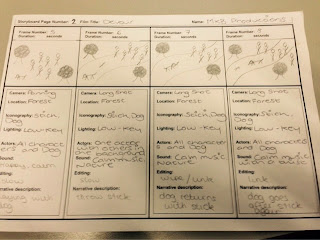
Another idea we took from Malu's individual narrative was the use of a dog. We decided that a realistic narrative that included all our ideas could be friends walking a dog in the forest. The use of a dog gives the scene a sense of reality and makes it easier for the audience to relate to this due to that most of the audience may have a dog themselves as it is a common domestic animal. We decided that most people are aware that dogs can usually sense a bad omen so therefore near the beginning of our scene when the dog goes missing after sensing a bad omen the audience will begin to realise the genre of our piece and also that something bad may happen to the characters they have already built a relationship with and related to for a stronger impact on them.
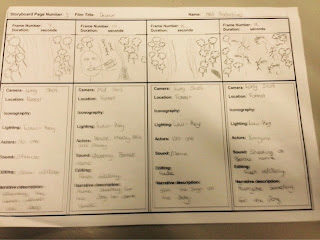
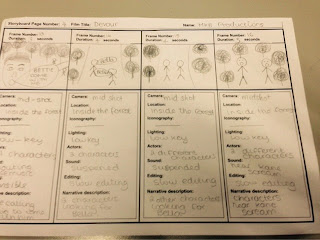
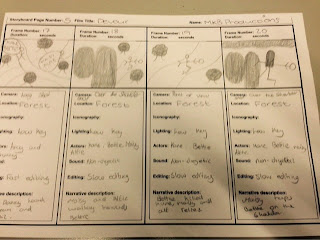

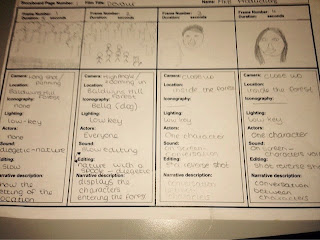
Group storyboards are a final copy of the shots and elements we will use when we film our piece. The purpose of a group storyboard is so that we can organise our filming schedule correctly so that all our shots are in the order we planned to save confusion and arguments and also include all the group members thoughts an ideas on what will work well and what won't work as well and give the group an opportunity to all agree on the right elements to include. The storyboards have been created by the whole group which we have included the best elements of every members individual storyboards to create a successful and effective opening thriller production.
These are images of our final storyboard which is concluded into 6 pages with 4 frames each. We used 24 frames and we hope we can time these to fit into our 2 minute time frame.
We made the storyboards to refer to throughout the whole process of making our opening thriller sequence. This is because when we are editing our piece we can refer back to our storyboard to remind us of our original ideas that we created to go into that scene and we can also stay organised so that the whole group is familiar with our narrative and also the different elements we will put into the scenes.
We took the idea of a forest setting from Kane's individual storyboard as we liked the idea of the vulnerability and the unknown of the forest that comes with it. We thought the forest setting would be perfect for our narrative which includes a chase scene with quite a large number of characters as it is such a big space with such a high possibility of getting lost which will keep our audience on edge which is conventional to the thriller genre. I had already thought about including the forest setting in my own narrative as I had got inspiration from a clip I analysed thriller conventions from which was Halloween H20 : 20 Years Later. I found this inspirational as I found myself being part of the audience that I instantly felt scared for the characters when I noticed they was in a dark forest, this is because the unknown of what may be lurking in the forest without the characters knowing themselves gives the audience a sense of foreboding.
The main idea of our narrative came from a combination of mine and Malu's individual narrative ideas of a cannibal. We both felt as though the use of the idea of cannibalism was unique and unusual and we could create an entertaining yet interesting storyline with this idea. Combining the idea with the forest setting we took inspiration from Kane's individual narrative we discussed the idea of friends walking their dog unknown to the fact one of their friends was really the cannibal and antagonist and there would be a cannibal attack during the dog walk.
Another idea we took from Malu's individual narrative was the use of a dog. We decided that a realistic narrative that included all our ideas could be friends walking a dog in the forest. The use of a dog gives the scene a sense of reality and makes it easier for the audience to relate to this due to that most of the audience may have a dog themselves as it is a common domestic animal. We decided that most people are aware that dogs can usually sense a bad omen so therefore near the beginning of our scene when the dog goes missing after sensing a bad omen the audience will begin to realise the genre of our piece and also that something bad may happen to the characters they have already built a relationship with and related to for a stronger impact on them.
In our piece we have planned to include a range of different shots and cinematography. To start with we have used mainly long shots, panning shots and a gradual zooming in technique. We have used these shots to show the setting and introduce our characters into the scene. I gathered my inspiration of gradual zooming in and panning shots from when I analysed cinematography and used a scene from Insidious. I felt as though when I watched the clip these shots stood out to me immediately for the purpose of causing tension. The slow pace of the shots creates tension for the audience and makes them feel as though something will pop out to scare them but it doesn't happen when they expect which scares them even more.
We have also planned to use different elements of cinematography to create different effects four our audience. I also gathered inspiration from a clip from Saw V when I watched it to analyse the mise-en- scene. The main shots used in this clip was close up shots and midshots. This was to clearly show the audience the characters facial expressions and body language to ultimately express how the character is feeling. The close up shots showed the characters uncomfortable and painful look which clearly told the audience that the character was experiencing extreme pain and brutality which made it a bit uncomfortable for the audience to watch which is conventional to the thriller genre. Therefore we have decided to include close up shots on key points in our production to clearly express to the audience how the characters are feeling. For example on the close up of the victims face when the antagonist gets revealed it will show a extremely shocked and frightened face to express their feelings but also show the audience that they are now in danger.
The last element we planned into the majority of our scenes was low key lighting. We got inspiration from the majority of the clips we analysed for example Halloween, Saw and Insidious. With the use of low key lighting it instantly gives the atmosphere a eerie and gloomy aura and makes the audience feel uncomfortable and get a sense of foreboding. The low key lighting represents danger, vulnerability and an enigma. It is also parallel to most of the elements included in that scene as it wouldn't combine with a joyful and happy narrative. All members of my group planned to include low key lighting in their own individual narratives as they believe that this gives the film a more frightening effect and will work well with our unusual and creepy narrative.

Sunday, 30 November 2014
Group Planning - Miss Georgiou
Group Planning
My group consist of three members, Kane Faulkner-Wild, Malu Pillai and myself. Group meetings are essential so that our group can come together weekly with different and new and improved ideas for our sequence that we may have thought of in our own time and want to share with the rest of our group. Group planning is essential to carry out in our groups because it helps us to stay organised and gives us the opportunity to discuss and evaluate all our group members ideas. Group planning also helps to develop ideas as all the group members can combine all the different individual ideas to produce better ideas.
In our first group meeting on the 13th of October we discussed each members of the groups individual narrative and their ideas for our own opening thriller sequence. Here we discussed the advantages and disadvantages of all the members different individual ideas and figure out how we could portray them into making a successful short thriller clip. We evaluated each members narrative and picked out the conventional parts of a thriller film in all of the ideas. We then tried to combine all of the ideas together to come up with our final group narrative. We took the idea of the forest setting from Kane's individual narrative. The idea we took from my own individual idea was the idea of using an unusual cannibal antagonist. We finally looked at Malus individual narrative and found that she also included a cannibal idea and a forest setting. Therefore we came to the definite decision of a cannibal antagonist as this is quite an unusual narrative and we we're going to film this in a forest setting. We decided that a forest setting was conventional to the thriller genre as it makes the characters seem vulnerable.
In our second meeting which was help on the 24th of October we discussed what sort of image we wanted to create in our opening sequence and what our final narrative would be. This is where we created our final group narrative of a group of friends who lose their dog in the forest and split up to find it, this is where the unidentified cannibal who is in fact one of the friends attacks the rest of the group. We wrote down and brainstormed all our different ideas onto paper and started to begin thinking what we would include in the different elements of thriller : cinematography, mise-en-scene, editing and sound. On this meeting we came up with the idea that we wanted low key lighting during our sequence and also wanted to use tense background music and also sound effects that would create jumpy parts to scare the audience. We also decided that we would use a close up shot and sharp sound effect on the reveal of our antagonist as this is a key part of out sequence. We discussed within the group our favourite thriller films and why these where our favourites due to the different elements included in them.
In the third meeting which was on the 6th of November we had a discussion on mise-en-scene. This included discussing lighting and colour, costume, iconography, settings and positioning of characters. The main ideas we come up with from our discussion was a forest setting, low key lighting throughout our sequence, we will put our characters in normal casual clothing so the audience can relate to them and identify the as students as this is hoe we want to represent the characters. The only use of iconography we decided to use was the dog, this is because due to our cannibal antagonist idea we don't need a use of weapons.
The next meeting we would have was for a discussion on editing techniques and this was held on the 10th of November. We looked through our books on the notes we had made previously on different editing techniques and when they were used and in what way to make an effect on the audience. The editing techniques we decided were most effective was montage editing and filters. We felt these were effective because the montage editing creates tension and makes the audience feel on the edge of their seat and the filters created an eerie and unsettling look. We also decided that the timing of the shots were very effective as they decide what feeling to give towards the audience and create suspense and scary parts for the audience which is conventional to the thriller genre.
In the next group discussion we was discussing sound. On a piece of paper all the members of my group brainstormed what sound techniques we found the most effective combined with the different shots of our opening thriller sequence. The techniques we came up with was diegetic and on screen sound as we can see where the sound is coming from which can sometimes portray a more frightening moment for the audience. We also all agreed as a group that sound effects were very effective in a thriller film, especially using a high pitch sharp sound effect on the reveal of our antagonist as this will scare our audience which is a convention of thriller films. We brainstormed on a piece of paper and wrote our ideas under four different headings which where non- diegetic sound, parallel sound, off screen sound and diegetic and on screen sound. We decided we would include all these different elements of sound in our own opening thriller sequence.
Our final group meeting was held on the 12th of November and we had a discussion on characters. We discussed how many characters we want to include and what they would be like, look like and what their background information would be. We decided that our own sequence would include 6 characters including me and Kane and 4 of our own friends from our media class. We decided we wanted to represent our characters as they are, students and of our same age group of 16 and 17. We decided to do this because the audience can relate to them as we have a target audience of teenagers roughly the same age as us as we have included elements that we enjoy ourselves so therefore will hopefully have the same effect on our audience. We decided that I would play the cannibal antagonist and Kane would be my victim. We decided that the other 4 characters would be our friends who reveal the narrative and that I am the antagonist and then be involved in a chase scene which is conventional to the thriller genre because it keeps the audience on the edge of their seat and creates tension in the opening of our thriller sequence.
{Table}
Group meetings and discussions are imperative to carry out as it gives us time as a group to develop concentrated ideas and also time to improve them. It helps us to plan out our thriller so it is as professional as it can be and so there is limitless amount of mistakes. I think that my group worked really well together as we stuck to all of our ideas unless we improved or developed them in some way. We was constantly discussing how we could improve our ideas and thinking of ways to make our thriller production better.
My group consist of three members, Kane Faulkner-Wild, Malu Pillai and myself. Group meetings are essential so that our group can come together weekly with different and new and improved ideas for our sequence that we may have thought of in our own time and want to share with the rest of our group. Group planning is essential to carry out in our groups because it helps us to stay organised and gives us the opportunity to discuss and evaluate all our group members ideas. Group planning also helps to develop ideas as all the group members can combine all the different individual ideas to produce better ideas.
In our first group meeting on the 13th of October we discussed each members of the groups individual narrative and their ideas for our own opening thriller sequence. Here we discussed the advantages and disadvantages of all the members different individual ideas and figure out how we could portray them into making a successful short thriller clip. We evaluated each members narrative and picked out the conventional parts of a thriller film in all of the ideas. We then tried to combine all of the ideas together to come up with our final group narrative. We took the idea of the forest setting from Kane's individual narrative. The idea we took from my own individual idea was the idea of using an unusual cannibal antagonist. We finally looked at Malus individual narrative and found that she also included a cannibal idea and a forest setting. Therefore we came to the definite decision of a cannibal antagonist as this is quite an unusual narrative and we we're going to film this in a forest setting. We decided that a forest setting was conventional to the thriller genre as it makes the characters seem vulnerable.
In our second meeting which was help on the 24th of October we discussed what sort of image we wanted to create in our opening sequence and what our final narrative would be. This is where we created our final group narrative of a group of friends who lose their dog in the forest and split up to find it, this is where the unidentified cannibal who is in fact one of the friends attacks the rest of the group. We wrote down and brainstormed all our different ideas onto paper and started to begin thinking what we would include in the different elements of thriller : cinematography, mise-en-scene, editing and sound. On this meeting we came up with the idea that we wanted low key lighting during our sequence and also wanted to use tense background music and also sound effects that would create jumpy parts to scare the audience. We also decided that we would use a close up shot and sharp sound effect on the reveal of our antagonist as this is a key part of out sequence. We discussed within the group our favourite thriller films and why these where our favourites due to the different elements included in them.
In the third meeting which was on the 6th of November we had a discussion on mise-en-scene. This included discussing lighting and colour, costume, iconography, settings and positioning of characters. The main ideas we come up with from our discussion was a forest setting, low key lighting throughout our sequence, we will put our characters in normal casual clothing so the audience can relate to them and identify the as students as this is hoe we want to represent the characters. The only use of iconography we decided to use was the dog, this is because due to our cannibal antagonist idea we don't need a use of weapons.
The next meeting we would have was for a discussion on editing techniques and this was held on the 10th of November. We looked through our books on the notes we had made previously on different editing techniques and when they were used and in what way to make an effect on the audience. The editing techniques we decided were most effective was montage editing and filters. We felt these were effective because the montage editing creates tension and makes the audience feel on the edge of their seat and the filters created an eerie and unsettling look. We also decided that the timing of the shots were very effective as they decide what feeling to give towards the audience and create suspense and scary parts for the audience which is conventional to the thriller genre.
In the next group discussion we was discussing sound. On a piece of paper all the members of my group brainstormed what sound techniques we found the most effective combined with the different shots of our opening thriller sequence. The techniques we came up with was diegetic and on screen sound as we can see where the sound is coming from which can sometimes portray a more frightening moment for the audience. We also all agreed as a group that sound effects were very effective in a thriller film, especially using a high pitch sharp sound effect on the reveal of our antagonist as this will scare our audience which is a convention of thriller films. We brainstormed on a piece of paper and wrote our ideas under four different headings which where non- diegetic sound, parallel sound, off screen sound and diegetic and on screen sound. We decided we would include all these different elements of sound in our own opening thriller sequence.
Our final group meeting was held on the 12th of November and we had a discussion on characters. We discussed how many characters we want to include and what they would be like, look like and what their background information would be. We decided that our own sequence would include 6 characters including me and Kane and 4 of our own friends from our media class. We decided we wanted to represent our characters as they are, students and of our same age group of 16 and 17. We decided to do this because the audience can relate to them as we have a target audience of teenagers roughly the same age as us as we have included elements that we enjoy ourselves so therefore will hopefully have the same effect on our audience. We decided that I would play the cannibal antagonist and Kane would be my victim. We decided that the other 4 characters would be our friends who reveal the narrative and that I am the antagonist and then be involved in a chase scene which is conventional to the thriller genre because it keeps the audience on the edge of their seat and creates tension in the opening of our thriller sequence.
{Table}
Group meetings and discussions are imperative to carry out as it gives us time as a group to develop concentrated ideas and also time to improve them. It helps us to plan out our thriller so it is as professional as it can be and so there is limitless amount of mistakes. I think that my group worked really well together as we stuck to all of our ideas unless we improved or developed them in some way. We was constantly discussing how we could improve our ideas and thinking of ways to make our thriller production better.
Tuesday, 25 November 2014
Individual Storyboards - Miss Miller
Individual Storyboard
In the last page of my storybaord it includes frames 17-20 and this is where all is revealed to the audience about what has happened and who the real antagonist is. Frame 17 is an over the shoudler shot as the two friends who heard the scream find kane laying on the floor whilst I am crouched over his body. To the audience this looks as though something unintentionally has happened to Kane and i am trying to help him. The two friends slowly walk up to me and kane as a piece of very tense music is played to present tension for the audience. The next frame 18 is a close up shot of my face, this is where the audience will realise i am a cannibal and the antagonist. I will have blood round my mouth and it will be evident to the audience that I have attacked kane. During this quick shot I have planned for a sharp high pitch sound to be played to create a shock element for the audience and to hoepfully make them jump. Frames 19 and 20 will be long shots to show the audience all of the friends panicing and trying to escape. This is the chase scene that we have planned to include in our group narrative. A chase scene is convetnional to the thriller genre because it makes the audience feel on the edge of their seat as the audience are left wondering whether the antagonist will catch the victims or not. This is where we have deicded to end our opening thriller sequence so that it is left of a cliff hanger for the audience.
We have created individual storyboards so that all the members of my group can put their own ideas into their own storyboard and include the different things that they think will work effectively such as lighting, sounds, cinematography and editing. I think that parts of my storyboard are very successfull and will be good to include in our final group storyboard. This is because it contains some conventional thriller elements and will create shock,supense,suprise and tensions for the audience. I think having our own individual storyboards will help us as a group when we draw our final group storyboard as we can all bring together our ideas and figure out what shots, lighting and editing techniques will be the most effective for our final opening thriller sequence.
The purpose of a storyboard is so that my group can visualise and start to piece together what our opening thriller sequence will look like. This will make it easier for our group to stay organised and understand what different shots, sounds and lighting tones we will use and where will we put them to create shock,suspence, suprise and tension. By creating a storyboard with all the features that will be added to it we can start to imagine in our group whether the shot will work effectively.
 |
| Frames 1-4 |
In my storyboard page 1 this is the very opening of our opening thriller sequence. This is where I have included mostly panning shots and close ups. My first frame is a simple panning shot to show the setting of the forest. The next frame will be a high angle shot which zooms in gradualy showing the characters entering the forest. Then the next two frames are two of our characters having a converstaion. I decided to include this because it gives our scene a sense of reality and makes it seem more realistic as the characters would be expected to be having a conversation whilst taking a walk in the forest. All of our shots have low key lighting as it will be filmed in the late evening and we want to make the atmosphere seem gloomy and dual. This is conventional to the thriller genre because low key lighting is used to create an enigma and it could also represent the antagonist or in our case the dark side of one of the characters as the audience doesnt know that the antaogonist is really one of the characters at this point. I've decided not to use any background music in these beginning frames as I believe the natural sounds of the forest in the dark will create an enigma and sense of foreboding for the audience.
 |
| Frames 5-8 |
In my next storyboard page 2 which includes frames 5-8 I have used mainly long shots excluding frame 5 were i have included a panning shot. Ive decided to use a panning shot here to show the narrative so the audience understand that the characters are on a dog walk in the forest. In frames 6-8 this is where the narrative starts to begin as Kane starts to play fetch with the dog. Frames 6 and 7 are showing the dog running after the stick and in frame 8 it is a repeated shot of Kane throwing the stick for the dog. I felt as though a couple of shots showing the dog bringing the stick back to Kane needed to be included so the audience wasnt suspicious and understood that the dog was capable of bringing the stick back. Therefore when the dog doesnt bring the stick back for a second time this will make the audience think that something bad may have happened to the dog. I've decided to still use low key lighting in these frames as nothing very important is happening in these frames and therefore a high key of lighting isn't neccessary. Also jsut the simple sounds of nature, dog barking and conversation will be heard in the background. This is so the audience do not suspect anything and makes the scene seem more realistic. This is conventional to the thriller genre because usually in thriller films they try to make everything seem calm and realistic before something bad happens to create more of a shock element for the audience.
 |
| Frames 9-12 |
Frames 9-12 include of my 3 page of my storyboard. This is where the narrative starts to get interesting and things start to take a turn for the worst. In this part this is where the audience may start to get a sense of something bad happening to the characters which is conventional to the thriller genre as the characters try to build a relationship with the audience so that when bad things happen to them they feel sympathetic and shocked. Frames 9 and 11 are panning shots which show a wide stretch of the empty forest to represent the dog isnt going to come back. During these shots a piece of tense background music will be played to create tension, I hope to include a sound with a heartbeat effect to represent this as Kanes heart as he fears for his dogs safety. Frame 10 is a mid-shot of Kane calling for his dog through the forest, this is to show the audience that Kane is no longer in control and begin to believe that the dog is really missing after she doesnt come back for a while. Frame 12 is an over the shoulder shot of Kane informing the other characters that they need to split up in the forest to find his dog. In this shot we can hear Kane talking but see the facial expressions of the other characters which is conventional to the thriller genre as usually the facial expressions of the characters seen in the shot are important. Here I have decided to use high key lighting, this is so that it is easier for the audience to see what is happening and so that they can easily spot different facial expressions of the characters.
 |
| Frames 13-16 |
This is the 4th page of my storyboard and this includes frames 13-16. During these frames this is where the characters split up into pairs and search different parts of the forest for Kanes dog. I decided that frame 3 is a vital shot. In this shot I have decided to include a mid shot of Kane telling me to come with him. I believe this may make the audience start to think that Kane is suspicious and may be a secret antagonist as he might have set all this up to prepare for an attack on me. However this will heighten the shock element when the audience find out I am really the antagonist. Frames 14 and 15 are long shots to show two different groups of pairs searching different parts of the forest looking for the dog. These shots are imperative just to make sure the audience are aware of the narrative and what is going on in the scene. Scene 16 is where the audience will first find out that something has gone wrong. I have included a close up shot of two of the characters faces whilst they are searching for the dog in a different part of the forest to me and Kane. However they hear a scream that sounds like its come from Kane, the close up shot will show their shocked facial expressions as they hear the scream from behind them. This is conventional to the thriller genre because its a clear representation of how the characters feel which helps the audience relate to them and help them to build relationships.
 |
| Frames 17-20 |
We have created individual storyboards so that all the members of my group can put their own ideas into their own storyboard and include the different things that they think will work effectively such as lighting, sounds, cinematography and editing. I think that parts of my storyboard are very successfull and will be good to include in our final group storyboard. This is because it contains some conventional thriller elements and will create shock,supense,suprise and tensions for the audience. I think having our own individual storyboards will help us as a group when we draw our final group storyboard as we can all bring together our ideas and figure out what shots, lighting and editing techniques will be the most effective for our final opening thriller sequence.
Tuesday, 18 November 2014
Planning Opening Credits - Miss Georgiou
Planning Opening Credits
The Style of Credits
The style of credits gives the atmosphere a jagged and hazed feel. This is because the font mirrors a child like style of handwriting and the credits appear on the screen all over the place and slightly blurred. This represents a mental and unstable character in the film. Also when the credits appear on screen there is short flashes of light on the words which makes them look as if they are being repeated and that they are not fully disappearing. This could relate to the antagonist in the film to give the audience the idea that the antagonist won't just disappear but will carry on killing victims. This helps add to the mental and unstable aura of the antagonist that the credits is trying to exemplify to the audience.
The Use of Thriller Conventions
A popular convention of thriller films is an unidentified or hidden killer/antagonist. This is ultimately to present an enigma and make it hard for the audience to build relationships with the antagonists. This convention is also portrayed in the opening credits of Se7en. The images used in the opening credits are extreme close up images which only ever show irrelevent parts of the body for example a finger or an eye. However these images create mystery and suspense as the audience feel there is a certain focus on these images and therefore this makes them think deeper into it. The images in the opening credits never show any characters or faces which makes the audience anticipate who the antagonist will be and this makes them more likely to want to watch the film. Another convention portrayed i the opening credits of Se7en that is conventional to the thriller genre is the iconography shown in the images. The iconography includes images of someone drawing in a book, a sharp blade and photos of the victims. These are conventional to the thriller genre because we usually expect the antagonist to plan his murder before the happening occurs.
The Order of Appearance
The order of appearance is important in the opening credits because it is what the audience take notice of. Therefore most films produce an order with the most popular names of actors near the front which will be appealing to the audience as a big actor they like may feature in the film and therefore this is the first thing they will see. The order of appearance in the opening credits to Se7en is production company, director, actor, title of film, actors continued, casting, music, costumes, editors, production, camera operator, co-producer, producer, writers and director. The reason for the repetition of the directors name at the end of the sequence is because the director is quite famous and recognisable. By having his name repeated twice it will be more obvious to the audience to notice it and recognise him. This may make the audience think that the film may be as good as other films he has produced in the past and therefore make them more likely to want to watch the film.
This is Kane's design idea that he created to use as part of our thriller sequence. I find that there are both many strengths and weaknesses to Kane's opening credit design idea. A strength of Kane's idea is the faded red colour underneath the title. This resembles blood which is conventional to the thriller genre and would give the audience an immediate understanding that our own thriller production may include blood and weapons which is a key convention of thriller films. This would help to create suspense as it would intrigue the audience as they would want to know who's blood it is and also the cause of the blood whether it is a person, animal or other being which may persuade them to want to watch the film. I also think faded black colour in the four corners of Kane's design idea is also effective. Black can represent many things in the thriller genre such as pain, evil and mostly death. This could represent that death may be included in our film which will make them sense the blood and the death could be linked and this may cause suspense to make them want to watch the film. Some weaknesses of Kane's design idea could be that the title itself could stand out more which would possibly make his design look more effective. He could maybe put a white fill instead of an outline which would make the title more bold and make it more eye-catching for the audience. Another weakness in Kane's design idea is that the font style and appearance doesn't really resemble the setting of our thriller piece whereas if it did this could be more effective. For example the pale beige brown colour used in the background could be a darker brown or musky green to resemble our setting of a forest. This would help the audience to understand a little knowledge of our film or make their own conclusions of the film before watching it which could be effective and ultimately make the audience more eager to watch our film. Overall I think Kane's idea of using the blood surrounding the font worked really well in giving the audience an idea of our thriller film and its narrative and I think it would have fit in well. However I believe that using this style credit for each credit entering the screen may look to much and a bit messy to have over our film.
This is Malu's design idea that she created for the opening credits to our thriller piece. There is also strengths and weaknesses that I analysed of Malu's opening credits. A strength of Malu's design idea is the characterized font on a plain black background. This is conventional because the black background makes the font bold and eye-catching which instantly catch the audiences attention and makes them wonder about the film as it doesn't give too much away about what may be included in the film. She has also included a blur effect over the font which may resemble a unclear and mysterious character or idea which may be part of the sequence. There has also been a yellow green colour inserted over the top of the font to resemble or setting of a forest however as this isn't entirely clear the audience could make there own interpretations of the colour scheme and what it may resemble as this also builds the intensity and keeps the audience anticipating. Due to the colours representing the forest being in the middle of the black background this could interpret danger being surrounded by the forest and also the people in the middle of the forest such like the font may be in danger. This would make the audience paranoid as they wonder who in the forest may be in danger and why. A weakness of Malu's design idea is that the font may be a bit small and unclear and it could be improved to make it more bold and to immediately stand out to the audience. I think that she could maybe do this by making the font a bit bigger and maybe adding a white or bright coloured outline around the font to ensure that it would stand out against a harsh black background. Overall I think that Malu's design worked really well and she thoroughly thought out her methods in interpreting the setting and danger of the characters into her font and credits and I think that he credit would fit in with the genre and narrative of our opening thriller sequence.
Opening credits are important in an opening thriller sequence because they inform the audience of the title of the film and also the starts that appear in it and directors and other important people that feature in the film. It also introduces the style and genre of the film and gives the audience an idea of what they should expect when watching the film.
This is the opening credits used in the thriller film Se7en (1995) directed by David Fincher. We analysed the different conventional elements to a thriller film and also analysed what we as an audience found out from the opening credits.
This is the opening credits used in the thriller film Se7en (1995) directed by David Fincher. We analysed the different conventional elements to a thriller film and also analysed what we as an audience found out from the opening credits.
Colour Scheme
The colour scheme used in the opening credits of Se7en is quite conventional. The black and white colour scheme represents good and evil theme but also the lack of colours presents a dark atmosphere. The colour black connotes darkness and also mystery which is conventional to an antagonist of a thriller film. Also the black connotes the evil antagonist whilst the white colour connotes a good protagonist.
The colour scheme used in the opening credits of Se7en is quite conventional. The black and white colour scheme represents good and evil theme but also the lack of colours presents a dark atmosphere. The colour black connotes darkness and also mystery which is conventional to an antagonist of a thriller film. Also the black connotes the evil antagonist whilst the white colour connotes a good protagonist.
The Style of Credits
The style of credits gives the atmosphere a jagged and hazed feel. This is because the font mirrors a child like style of handwriting and the credits appear on the screen all over the place and slightly blurred. This represents a mental and unstable character in the film. Also when the credits appear on screen there is short flashes of light on the words which makes them look as if they are being repeated and that they are not fully disappearing. This could relate to the antagonist in the film to give the audience the idea that the antagonist won't just disappear but will carry on killing victims. This helps add to the mental and unstable aura of the antagonist that the credits is trying to exemplify to the audience.
The Use of Thriller Conventions
A popular convention of thriller films is an unidentified or hidden killer/antagonist. This is ultimately to present an enigma and make it hard for the audience to build relationships with the antagonists. This convention is also portrayed in the opening credits of Se7en. The images used in the opening credits are extreme close up images which only ever show irrelevent parts of the body for example a finger or an eye. However these images create mystery and suspense as the audience feel there is a certain focus on these images and therefore this makes them think deeper into it. The images in the opening credits never show any characters or faces which makes the audience anticipate who the antagonist will be and this makes them more likely to want to watch the film. Another convention portrayed i the opening credits of Se7en that is conventional to the thriller genre is the iconography shown in the images. The iconography includes images of someone drawing in a book, a sharp blade and photos of the victims. These are conventional to the thriller genre because we usually expect the antagonist to plan his murder before the happening occurs.
The Order of Appearance
The order of appearance is important in the opening credits because it is what the audience take notice of. Therefore most films produce an order with the most popular names of actors near the front which will be appealing to the audience as a big actor they like may feature in the film and therefore this is the first thing they will see. The order of appearance in the opening credits to Se7en is production company, director, actor, title of film, actors continued, casting, music, costumes, editors, production, camera operator, co-producer, producer, writers and director. The reason for the repetition of the directors name at the end of the sequence is because the director is quite famous and recognisable. By having his name repeated twice it will be more obvious to the audience to notice it and recognise him. This may make the audience think that the film may be as good as other films he has produced in the past and therefore make them more likely to want to watch the film.
My Groups Opening Credit Design Ideas
Each member of my group including me created our own opening credits to our thriller sequence. We created these credits on the programme Final Cut Pro X. We interpreted all our ideas into these credits before showing them to our group members and analysing the strengths and weaknesses of each others work.
This is an example of the opening credits I created for my own thriller sequence. The title of our film is Devour so I tried to make this stand out the most. I done this by making the title font bigger in size than the rest of the subtitles and also by changing the colour to red. This is not only conventional to opening thriller credits due to the main focus of the title but also due to the title being in red. Having the title in the colour red is conventional because the colour red usually represents blood, pain, brutality and death.
The positioning of the title in the middle makes it clearly stand out well and also shows the audience that this is clearly an important part to the sequence and gives them an understanding of what out sequence may be about and gets them thinking about what they may expect to see. The different titles will come in from different directions of the scene. This kind of represents the chase scene in our sequence, this is because the antagonist is the big and powerful being who chases the victims into different directions. This could represent the antagonist being the title "DEVOUR" and the other pieces of information such as the subtitle and actors names will come in at different directions.
 |
| My Design Idea |
These are my other group members opening credit design ideas:
 |
| Kane's Design Idea |
This is Kane's design idea that he created to use as part of our thriller sequence. I find that there are both many strengths and weaknesses to Kane's opening credit design idea. A strength of Kane's idea is the faded red colour underneath the title. This resembles blood which is conventional to the thriller genre and would give the audience an immediate understanding that our own thriller production may include blood and weapons which is a key convention of thriller films. This would help to create suspense as it would intrigue the audience as they would want to know who's blood it is and also the cause of the blood whether it is a person, animal or other being which may persuade them to want to watch the film. I also think faded black colour in the four corners of Kane's design idea is also effective. Black can represent many things in the thriller genre such as pain, evil and mostly death. This could represent that death may be included in our film which will make them sense the blood and the death could be linked and this may cause suspense to make them want to watch the film. Some weaknesses of Kane's design idea could be that the title itself could stand out more which would possibly make his design look more effective. He could maybe put a white fill instead of an outline which would make the title more bold and make it more eye-catching for the audience. Another weakness in Kane's design idea is that the font style and appearance doesn't really resemble the setting of our thriller piece whereas if it did this could be more effective. For example the pale beige brown colour used in the background could be a darker brown or musky green to resemble our setting of a forest. This would help the audience to understand a little knowledge of our film or make their own conclusions of the film before watching it which could be effective and ultimately make the audience more eager to watch our film. Overall I think Kane's idea of using the blood surrounding the font worked really well in giving the audience an idea of our thriller film and its narrative and I think it would have fit in well. However I believe that using this style credit for each credit entering the screen may look to much and a bit messy to have over our film.
 |
| Malu's Design Idea |
In our opening sequence we are planning to have our opening credits give information on the title, actors names, director, director of photography, editor and also the producer. All the different opening credits will come in order of importance. We will have the actors names first and we will also make sure our title isn't the last credit to appear as this resembles a trailer. The opening credits will all come onto the screen in a different direction that the one before . This is to resemble the chase scene in our sequence and the unstableness and vulnerability of the victims. Just like Se7ens opening credits where the credits appears jagged and looked as if they was all over the place on the screen to resemble the unstable and mentality of the antagonist.
Subscribe to:
Posts (Atom)